Growth strategy
Fractional CMO or full-time hire? The questions to ask first
An honest guide for founders: when fractional works, when it doesn't, and what to expect.
Should you hire a full-time CMO, or bring one in two days a week? Founders weighing this usually want a clear answer.
I don't have one for everybody, and I've done both. I've been a full-time CMO at software companies where marketing had to be built from nothing, and I work today as a fractional CMO for a US AI startup. Each model works well in some situations and badly in others.
The right answer depends on your company, and a handful of questions will get you there faster than any general rule.
1. Do you need someone to build, or someone to steer?
If marketing doesn't exist yet, or has to be rebuilt from the ground up, you're asking for a lot of hours. Hiring the team, setting up the tools, fixing the positioning, running the first campaigns, sitting in every pipeline review. That's a full-time job, and trying to fit it into two days a week usually means everything moves slowly.
If the foundations are there and what's missing is senior direction, fractional works well. Someone who sets the strategy, makes the hard calls, and keeps the team pointed at the right number.
2. Who will do the work?
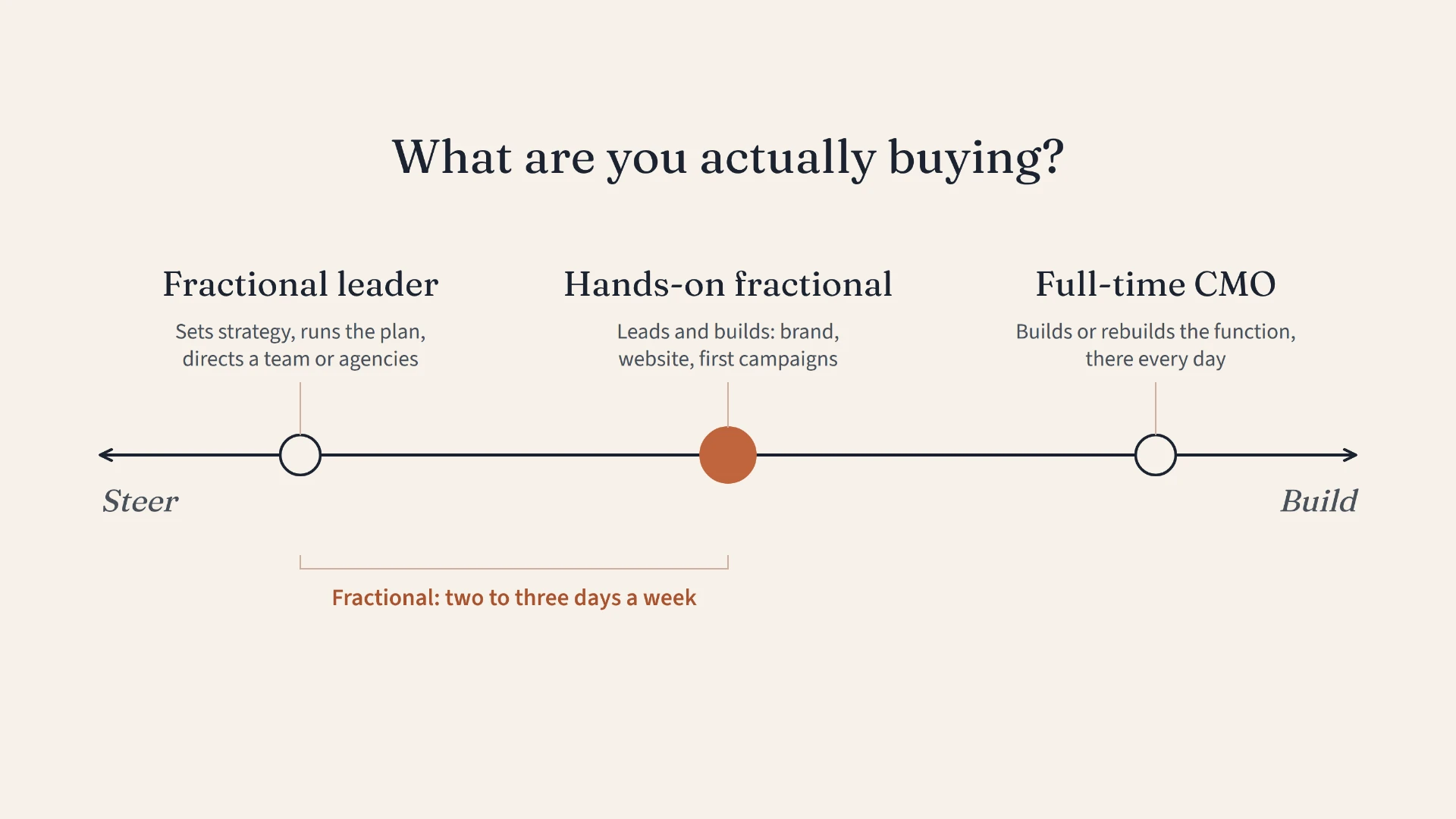
Fractional CMOs come in different shapes. Some mostly lead: they set the strategy, run the plan, and direct a team or agencies. Others are hands-on builders: they write the positioning, shape the brand, get the website live and run the first campaigns themselves.
Both are real. For an early-stage company with no marketing team, the hands-on version is often exactly right. AI and no-code tools have made it more realistic too: one experienced person can now build a website, a content engine or a set of campaigns that used to need a small team.
The trade-off is time. Every day spent building the website is a day not spent on strategy, sales alignment or the leadership team. That's fine when building is what the company needs most. It becomes a problem when you hire a fractional CMO for strategy, then fill their days with execution because nobody else can do it.
So decide what you're buying. If you need both, say so, and plan for when the building phase ends and someone else takes over the day-to-day: a marketing manager, a couple of specialists, an agency or freelancers.
3. How settled is your go-to-market?
If you already know who you sell to, what problem you solve and how deals get done, a fractional CMO can sharpen it and scale it.
If those answers are still moving, you need someone close to the product, the sales team and the customers every day. Positioning work happens in a lot of small conversations, and part-time presence makes that harder.
4. How much of the job is inside the leadership team?
In every company where I've led marketing full-time, I sat on the executive committee. A lot of the job happened there: budget discussions, hiring plans, investor meetings, arguments with sales about what counts as a good lead.
If you're preparing to raise money, or marketing and sales need a real reset, that seat at the table matters. A fractional CMO can join leadership meetings, but if the job is mostly internal alignment, a full-time leader has more weight.
5. What can you afford, honestly?
A senior full-time CMO is one of the biggest salaries on a startup's payroll. Hiring one too early can eat the budget that should have gone into programs and people.
Fractional gives you senior judgment without that commitment, and it leaves money for execution. For many early-stage companies, that's the deciding factor.
6. How long do you need this?
Some needs are temporary: a launch, a repositioning, getting marketing ready for a Series A, covering a gap between hires. Fractional fits those well.
Some needs are permanent: a growing team, a long enterprise sales cycle, a market that needs constant attention. Those point to a full-time role, even if fractional is the right way to start.
When fractional works best
- The product works, and you need structure and senior judgment more than raw hours.
- There's a small team or agency to execute, or the first job is a defined build, like a brand or a website.
- You want senior experience before you can justify, or find, the right full-time hire.
- The need is tied to a moment: a launch, a new market, a funding round.
When full-time is the better call
- Marketing has to be built or rebuilt from scratch.
- The team is growing and needs a leader who is there every day.
- Marketing needs a real seat in leadership decisions, fundraising and board discussions.
It doesn't have to be one or the other
Some of the best arrangements start fractional and become full-time. You get to see how someone works with your team before making the bigger commitment, and they get to see whether the company is the right fit for them.
Whichever way you go, be clear about what you need. "We need marketing" is too vague for either model. "We need 40% of our pipeline to come from marketing within a year, with a team of three" gives anyone, fractional or full-time, something real to work toward.