Growth strategy
ABM only works when sales and marketing share the list
Account-based marketing fails as a marketing-only project. It works when both teams pick and work the same accounts.
Account-based marketing sounds simple. Pick the companies you most want as customers, and focus your marketing on them instead of chasing volume.
In practice, a lot of ABM programs quietly fade out after six months. The software gets renewed, the dashboards look busy, and sales keeps working its own list as if nothing happened.
I've spent years on both sides of this. I was CMO of an ABM software company, Jabmo (formerly Azalead), and later ran ABM as the backbone of marketing at Cosmo Tech, an enterprise AI company. The programs that worked had one thing in common: sales and marketing were working the same list.
How ABM usually goes wrong
Marketing buys a data tool, builds a list of target accounts based on company size and industry, and launches ads and content aimed at them. A few weeks later, the reports show engagement going up.
Then someone asks sales about those accounts. Half of them, they've never heard of. A few they've already ruled out. And the accounts they actually care about aren't on the list.
Marketing is doing account-based marketing. Sales is doing what it always did. Nobody is doing ABM together, and that's the only version that works.
Pick the list together
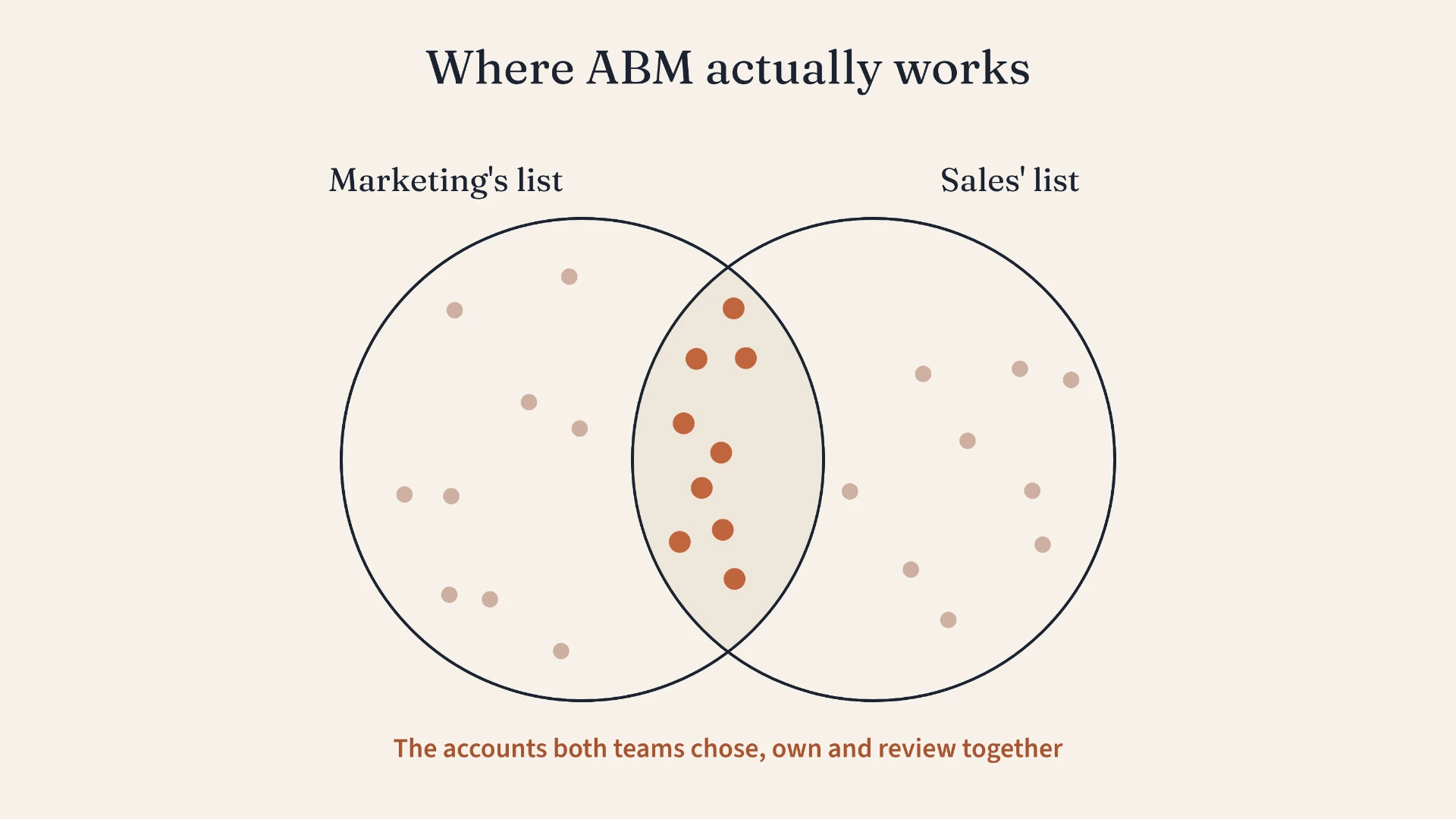
Put sales, marketing and whoever owns revenue in the same room, and agree on the accounts. Use data to shape the list, but let sales add what data can't see: existing relationships, deals that stalled last year, a champion who just moved to a new company.
Keep the list small enough that the team can actually cover it. Every account on it should have a named salesperson who agrees it belongs there.
Agree on what happens when an account wakes up
The point of ABM is to notice when a target account starts paying attention, and act on it. That only works if both teams have agreed, in advance, what counts as a signal and who does what next.
If three people from one target account visit your pricing page in a week, who calls them, and by when? If that isn't decided, the signal gets lost between two teams.
Work as one team
ABM works when sales and marketing act like one team, not two departments passing leads over a wall. I call it the same team mentality, and it's the part most ABM programs underestimate.
In practice, marketing sits in the sales meetings. And at the very least, the ABM or growth manager meets regularly with each salesperson, one to one, to go through their accounts, agree on priorities and decide the next actions together.
Those conversations are where a target list turns into a real plan: which accounts to push this month, which people to reach, and what content, event or introduction would help open the door.
Sales development reps are often the link that makes this work day to day. They follow up on account signals, research the people involved, and open conversations that account executives can take over.
At Jabmo, I trained and implemented an SDR program specifically to support our demand generation and ABM strategy. It gave marketing's work on target accounts a direct path into sales conversations.
Review accounts, not leads
The weekly meeting changes. Instead of counting leads, sales and marketing go through the target accounts together: which ones are engaging, who we're talking to, what's blocking the next step, and what marketing can do to help.
That meeting is where ABM either becomes a shared habit or drifts back into two separate plans.
Measure what matters to both teams
Measure at the account level. How many target accounts are engaging? How much pipeline comes from them? What share of qualified leads do they produce?
At Cosmo Tech, working this way with sales, half of our target accounts engaged with us, and 80% of our sales-qualified leads came from those target accounts. Those numbers mattered because both teams had picked the accounts, so both teams cared about the result.
The hard part
The software, the ads and the content are the easy part of ABM. The hard part is two teams agreeing on a short list of names, and sticking to it week after week.